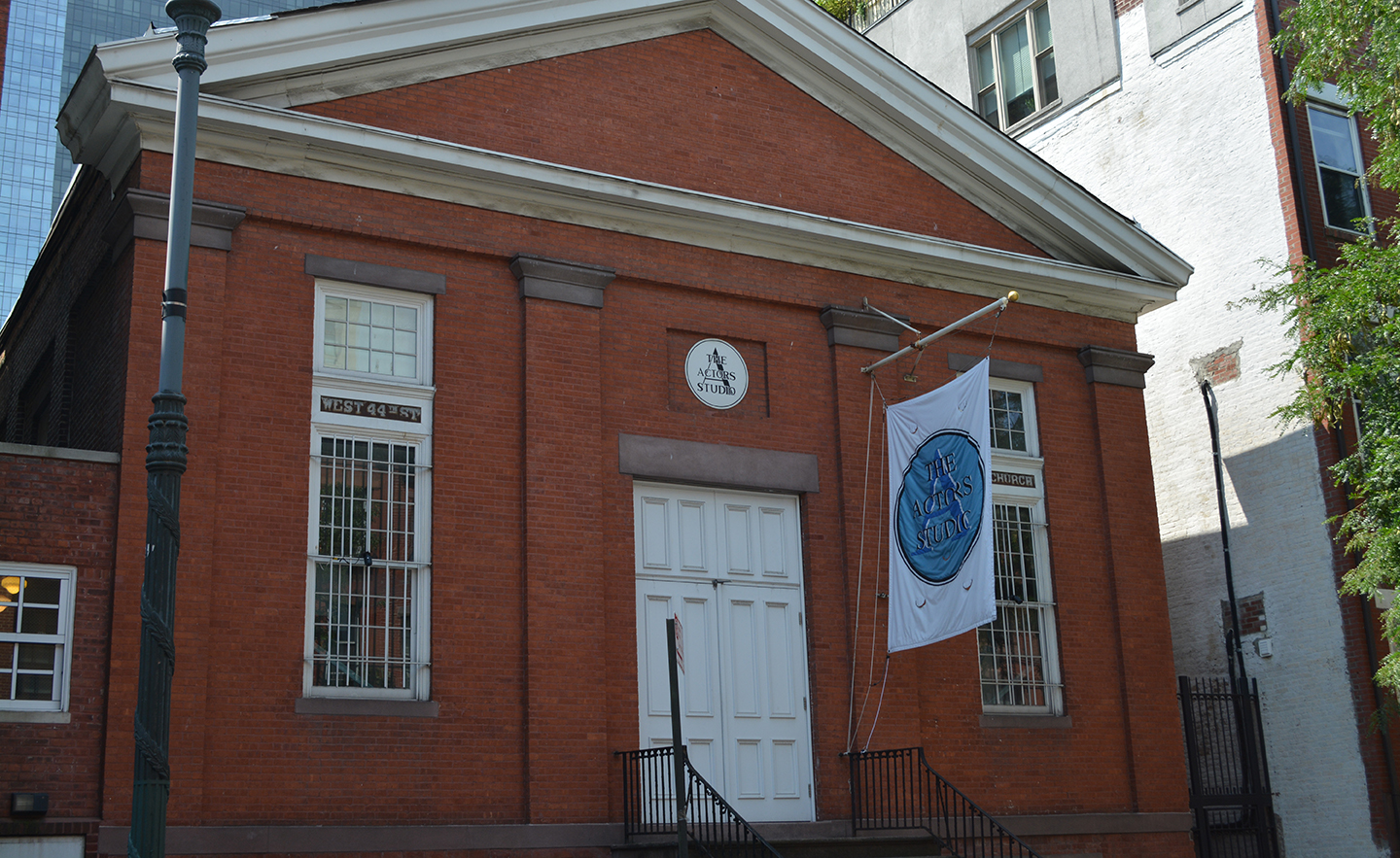
In recent years, visitors to New York seeking serious theater inevitably find themselves drawn beyond the glitz of Broadway and Ninth Avenue to a humble, two-story church building in a neoclassical Greek style. Surrounded by drab apartment buildings, it sits just a few feet back from the sidewalk, enclosed in front by black-painted iron railings. A small sign identifies it as the Actors Studio. The visitor must ignore the brownstone steps leading to the double doors at the front and enter through a basement door.
Walking through the lower level, the visitor—students and theater professionals have the privilege of seeking special access—encounters various busy offices with bulletin boards and telephones, a quieter waiting area flanked by two doors marked “Oh, Men” and “Oh, Women” (a reference to a successful production by Cheryl Crawford, one of the Studio’s founders), and, at the back, a large, sunlit rehearsal hall overlooking a courtyard where the Studio hopes to one day build additional rehearsal space. Hanging on the walls are photographs of Eleonora Duse and Stanislavski, autographed theater posters from European companies that have visited the Studio, and—a less conventional touch—prints of David Garrick, Edmund Kean, John Philip Kemble, and Mrs. Siddons.
A narrow staircase leads up to the actual Studio. The space that was once the church sanctuary still retains its original horseshoe-shaped balcony and high ceiling. The old windows, wooden ceiling, narrow balcony, and blue-and-white color scheme all give the feel of a Georgian-era theater. Where the pulpit and choir once stood, there is now a stage extending deep into the space, covered with worn linoleum. There are no curtains or a framed proscenium, and the seating capacity is small—perhaps two hundred people at most, sitting on wooden chairs both at floor level and in the balcony.
Every Monday and Friday, the seventy members of the Actors Studio gather around 10:30 AM. One of the students presents a prepared scene. The scene might be from Chekhov, Strindberg, O’Neill, or even a work in progress by one of the members. Two or more actors rise, stand somewhat hesitantly before the audience, and perform their scene. One by one, they explain the problems they are working on. Occasionally, the actors will be asked to repeat the scene so that Strasberg can comment as it unfolds. Often, the audience is invited to give feedback. Finally, Strasberg himself begins to speak. He may talk for ten minutes or sixty, but usually, his remarks last only fifteen or twenty minutes because a second scene must be accommodated before the session ends around 1:00 PM.
That’s all.
Strasberg leaves quickly to make it to another class, and the members disperse to their homes, jobs, or remain to rehearse another scene. The casual visitor may feel somewhat perplexed.
“Is this the world-famous Actors Studio? Is this the birthplace and home of stars? Could these simple procedures really be the legendary ‘Method’?”
Perhaps the visitor has heard an eloquent speech from Strasberg. Perhaps they have witnessed intense emotions, actors crying—both on stage and in the discussion afterward. Or they may have seen something that looked like child’s play or a random “wandering” around the stage. The actors may have spoken about problems that seemed completely insignificant or trivial to the visitor.
The visitor may leave 44th Street wondering what all the fuss is about.
But the people at the Studio don’t particularly care what the visitor thinks. Many of them have attended these two-hour weekly sessions since 1947. To them, the Studio is a private workshop. The visitor has been granted the privilege of watching professional craftsmen at work, and their personal reactions are ultimately irrelevant.
Every artist needs a space—a “studio”—where they can practice their scales, experiment with new colors, make mistakes, invent, and test themselves. One of Strasberg’s guiding principles is summed up in a favorite quote from Goethe:
“The actor’s career develops publicly, but his art develops privately.”
However, Goethe’s quote needs a slight modification. An actor truly needs other people to advance in both their art and their craft.
The Actors Studio provides them with both colleagues and privacy. There, art can truly evolve, and the perceptive visitor will almost certainly walk away from even a casual visit with a sense of dedication, seriousness, hard work, determination, and professional integrity.