Topic: Training
The first known publication on Stanislavski-based training dates back to 1919. At that time, the magazine Gorn, published by Proletkult (Proletariat and Culture), featured two articles by Mikhail Chekhov about the system, describing some of its exercises.
Mikhail Chekhov, then a brilliant actor at the Moscow Art Theatre, was deeply influenced by Nietzsche, Vladimir Solovyov, Schopenhauer, and the philosophy of yoga, which, as he wrote, he “absorbed objectively, though without hoping for a new worldview, and without the slightest internal resistance.“
In the 1920s, he became deeply involved in the anthroposophy of Rudolf Steiner. The Chekhov Studio, which he directed at the time, was closely connected to other studios led by Stanislavski’s students—including the First Studio, Vakhtangov Studio, and Habima, where joint classes were often held.
In his first article, Mikhail Chekhov outlined the fundamental principles of the system as follows (a tone characteristic of both articles):
- “The system gives the artist the key to his own soul.“
- “The body traitorously commits the crudest violence against the soul.“
- “The system helps the actor set boundaries for the body and protects the soul from such violence.“
- “The actor’s work on himself consists in developing the flexibility of his soul.“
The publication of this article provoked objections from Yevgeny Vakhtangov. In the magazine Theatrical Bulletin, he published a response titled:
“To Those Who Write About Stanislavski’s System.”
(Note: The phrase “to those” was a rather sharp remark, especially considering his great friendship with Chekhov.)
Vakhtangov expressed disappointment with Chekhov’s statements, arguing that if Chekhov aimed to provide a comprehensive and detailed description of the system, he had failed—since such a description could only be given by Stanislavski himself.
He accused Chekhov of sharing details out of context, failing to explain the origins of the system, and giving the impression that he was extensively analyzing how to train a student—something impossible to cover in just three or four pages of a magazine.
The Mysterious Second Article
It is likely that criticism from his peers pushed Mikhail Chekhov to develop the practical side of training in greater detail in his second article, titled:
“On the Actor’s Work on Himself.”
Interestingly, this article appeared in Gorn without a signature. Chekhov’s name was nowhere on the article—and this was certainly not an editorial oversight.
This second article described:
- 13 model exercises “for attention”
- 15 exercises “for faith, naïveté, and imagination.”
Mikhail Chekhov identified attention as the primary element of the creative state, defining it as intense and focused concentration.
One exercise instructed students to try to “implant a specific thought into someone.”
Other exercises—such as “listen to a specific sound” or “examine the pattern of wallpaper”—shared the same fundamental goal: developing focused attention.
Mikhail Chekhov urged students to “listen to the subtle, elusive images of the imagination and always strive to capture the original image.“
He promised more articles, but none followed.
The next issue of Gorn contained nothing about the system, and the first issue of 1920 instead presented a transcript of a lecture by V. Smyslyaev (who had previously taught at Chekhov’s studio).
In this lecture, Smyslyaev argued that realism had become an obstacle to the further development of theater, and that a new form of proletarian art needed to be found. (Politics in Theatre…)
However, Smyslyaev later released a book in 1921 titled:
“Theory of the Processing of Stage Spectacles”
—a book that essentially presented Stanislavski’s system but reinterpreted through Smyslyaev’s perspective.
Politics and the Fate of Theatres
In the same issue of Gorn, V.A. Likhovid dismissed all of Moscow’s theaters:
- “Tairov’s Theatre,” he wrote, “will be rejected…“
- Meyerhold’s Theatre “wants to, but cannot,” and is therefore not a model for proletarian art.
- “The Maly Theatre and the Moscow Art Theatre will be thrown into the trash heap of history by the working class, as they represent deliberate sabotage and bourgeois provocation.” (Politics in Theatre… again.)
Stanislavski’s Response
Stanislavski observed the political turmoil and responded to such criticisms with the following remark:
“There is a rush to adopt external form… Many have prematurely decided that experience and psychology are merely hallmarks of bourgeois art, while proletarian (art) should be based on the physical (external) cultivation of the actor…
But surely, the complexity of modern artistic form did not arise from a “primitive taste” of the proletariat—it arose from the refinement and artistic sensibilities of the former bourgeois audience.
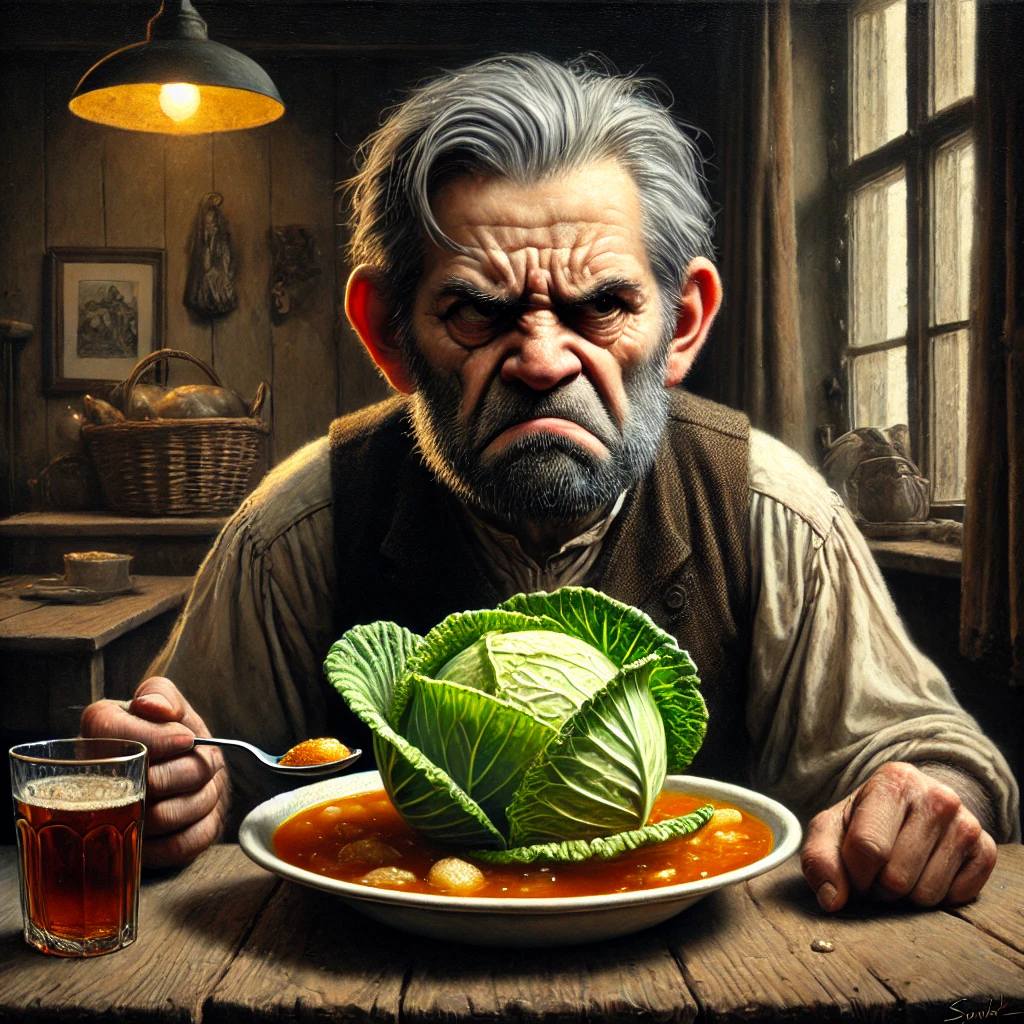
Surely, modern grotesque is not a product of excess, but, as the saying goes, ‘when one has fine food before them, suddenly they crave boiled cabbage.’“