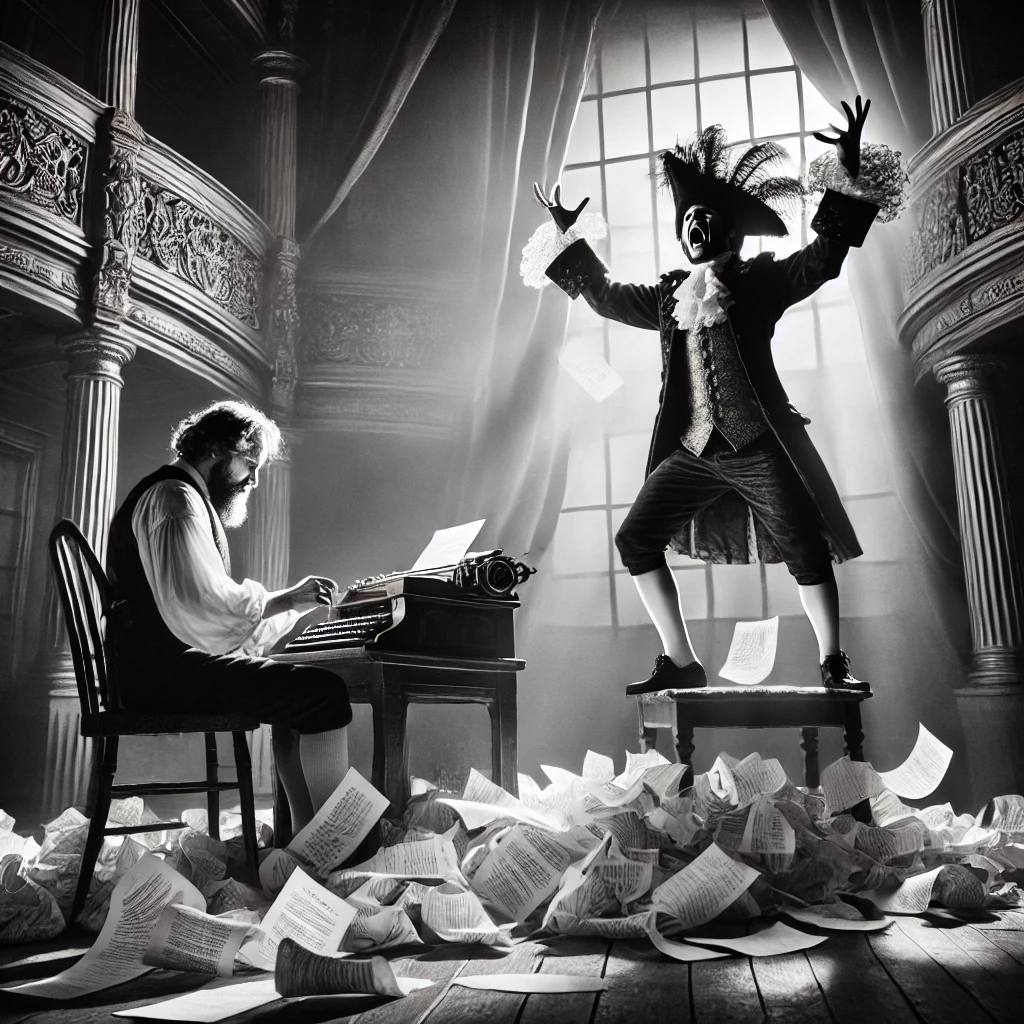
This particular approach to the author is not always present in theater. Nowadays, the antagonistic relationship between the performer and the writer is considered entirely normal. In recent years, a peculiar term has emerged: “transcendence.”
Today, you gain no recognition if you solve the mystery of the playwright, if you open yourself up to them, draw inspiration from their ideas, or “walk in their shoes.” You must “transcend.”
To allow the playwright to inspire you and create something mysterious, according to the known natural laws of art? Not even a foolish notion! You must “transcend.”
It is true that, at times, a writer is so mediocre that you must summon all your creative power to “transcend” their mediocrity, their ignorance of dramaturgy, and their lack of refinement.
The problem is that we often treat classical works in the same way. Instead of acknowledging that a play is challenging and demanding, we frequently say: “This play will tire a modern audience; they won’t be interested; today’s audience needs more action and dynamism.” And so, the “transcendence” begins. Large portions of the text are deleted, new scenes are added, and the performance is “brightened” with entertaining, additional sequences.
The play, distorted and stripped of its original meaning and power, is presented to the audience in a “transcendent” form.
Instead of profound meanings, grand emotions, and the struggle of eternal passions, it is given an external sheen and superficial entertainment. It becomes easy and enjoyable to watch…
However, there is another form of “transcendence” that, for some reason, is particularly encouraged in our time.
Great writers, such as Gogol, rewrote their works multiple times. Their first drafts were so weak and primitive that it was hard to imagine they were written by the same author. The issue, however, is simple: in order not to lose their thoughts, they made quick notes, capturing them in a raw, unrefined form. Later, step by step, from draft to draft, the work evolved until it acquired the form and perfection we recognize today.
Yet, today, it is considered a great achievement to stage a play based on its first draft—on the notes that the poet himself discarded as worthless.
If we were talking about cuts due to censorship, that would be a different matter. But no! For some inexplicable reason, directors become fascinated with the early, incomplete attempts of writers, from a time when they were still exploring the darkness.
Most often, it is the director who “intervenes” in the playwright’s work this way. At other times, it is the “transcendence” of the actor that leaves the audience bewildered.
Who among us has not seen the titanic character of Hamlet “transcended” and reduced to a neurotic or a shallow philosopher with a pleasant appearance and a good voice?
Who has not seen a vulgar, uncouth Othello instead of the noble hero? Or a loud, empty brawler?
Instead of elevating himself to the role and surpassing his own limitations, the actor, without hesitation, reshapes the role to fit his own dimensions. He shortens the legs, cuts off half the head, and says: “It doesn’t matter! It should have fit me from the beginning anyway!”
“Transcendence” can also be positive. An actor and director may succeed in creating a vivid, convincing, and expressive character out of useless or artificial material from the playwright. This is service; it is sacrifice; it is a feat.
If it is absolutely necessary to stage such a deficient work or interpret such a role, then it is obvious that you cannot leave it uncorrected. You cannot tolerate ignorance; you cannot allow bad taste; you must enhance the writer’s lack of imagination and thought.
How could it be otherwise? The life of a true artist is full of such feats. This should come as no surprise.