
Part A
(By Robert Cohen)
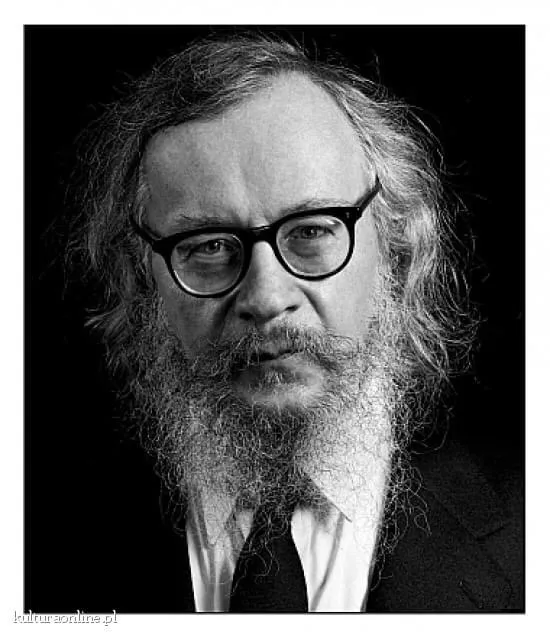
In the winter of 1982–83, Professor Andy Harris of Columbia University contacted David MacDonald with an intriguing proposal: Jerzy Grotowski was in the United States and wanted to visit California. Andy wanted to know if we were interested in such a visit and perhaps a series of lectures from Grotowski at various universities in the region. David brought the proposal to me (I was department chair at the time), and I was thrilled. In 1965, during my first year at UCI, the Dean had left a pamphlet in my office announcing Grotowski’s “retirement” from theatre. Attached to the pamphlet was a handwritten note (post-it notes didn’t exist back then) saying, “Here’s what your hero, Bob, decided to do.”
Now, 20 years later, I rushed into Jim Slowiak’s acting class (Jim was a devoted follower of Grotowski and would soon become his right-hand man), shouting, “Jim! We’re bringing your hero here!” It felt like poetic justice.
I secured a substantial grant from the university’s administration for Grotowski’s lecture series. Jerzy delivered two talks—one on his production of Faustus and another on his Theatre of Sources. After these lectures, I found a reason to travel to New York to meet him. At a dinner organized by Andy Harris in Grotowski’s honor, Jerzy arrived at the restaurant poorly dressed in a tight jacket and an old tie. He greeted me warmly with three kisses on the cheek and immediately ordered filet mignon and Armagnac (France’s oldest distilled spirit). He explained that the filet was a prescription from his doctor for a rare blood and liver condition. The three kisses were a tradition that would repeat in future meetings.
That day, we spoke exclusively in French, as Jerzy’s English was limited. We discussed various topics—Marcel Marceau, local news, politics in his homeland, and the upcoming lectures I had arranged for him. Suddenly, I realized that Jerzy wasn’t interested in just giving lectures. He was searching for a new home. None of us knew it at the time, but he had already emigrated to America and wouldn’t return to Poland for years.
Jerzy wanted to start a new project, which he later called the “Objective Drama Project.” This project was a synthesis of his research on various cultures through his Theatre of Sources and his earlier work in theatre as a director and producer. Specialists from around the world would teach ancient rituals and performance techniques to students, who would then create new performances with a sense of primal authenticity. For me, it was like manna from heaven.
I returned to California and immediately began the process of incorporating him into the university’s program. Our department wasn’t known for pedagogical innovation. Our acting professors came from more traditional schools: the Royal Shakespeare Company, the Stratford Shakespeare Festival in Canada, Kurt Conway, the Group Theatre, and others like myself, Keith Fowler, and Dudley Knight from Yale’s Drama School. Jerzy seemed like the perfect addition to our program. With unanimous support from the faculty, I approached the university administration even before Jerzy’s arrival. By March/April 1983, when he finally arrived, we were already in tough negotiations.
At first, things looked promising. Jerzy stated that he enjoyed California immensely and referred to the university staff as his “new family.” Nothing could have prepared me for how wrong I was.
We soon encountered serious challenges. Creating a research space for Grotowski was like trying to fit a tree into a box. The university, with its endless paperwork and rigid bureaucracy, was the box. Jerzy, the Polish guru and visionary, was the tree—standing far outside that box.
Securing his position at the university was the easiest part of my mission, despite funding difficulties. The university offered him a professor’s position at salary scale VI—the highest rank in the department and 11 full steps above the academic ladder. I felt a sense of relief when Jerzy accepted the salary offer without questions or negotiations.
Everything else in his contract, however, became a point of negotiation down to the last detail. Jerzy requested $200,000 a year for expenses, $25,000 for equipment, and $10,000 for phone charges—an amount far exceeding the entire theatre department’s budget, both then and now. The university had only 5% of the funds he requested. I tried to remind him of his reputation in Poland for “poor theatre,” to which Jerzy responded, “Poor theatre costs a lot of money.” I would soon learn that this was a phrase he used frequently…
Copyright 2022 Kimon Fioretos, All Rights Reserved.