
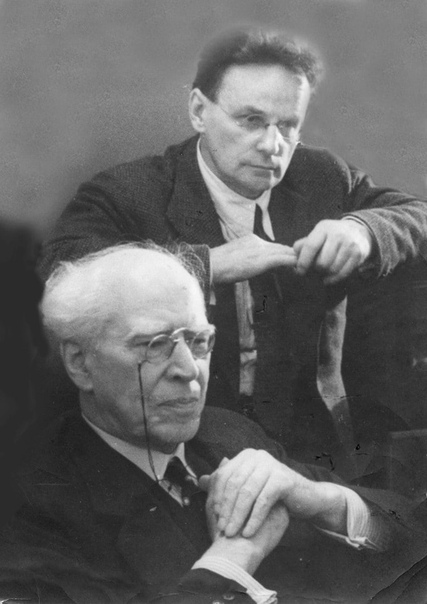
The history of modern acting often focuses on the work of Konstantin Stanislavski, overlooking how deeply he was influenced by the innovative ideas of Nikolai Demidov. However, to understand how the art of acting evolved from “the system” into a more holistic and instinctive approach, it is essential to examine how the concept of the “fourth floor” connects to training and drill and how Demidov corrected Stanislavski’s course at critical moments.
The “Fourth FLOOR”: A Delayed Shift
Stanislavski dedicated his life to developing a system that would provide actors with the tools to achieve truth on stage. In his early years, the system focused on fragmented “elements”—attention, imagination, memory, and analytical thinking. But the obsession with elements proved restrictive. His actors ended up delivering mechanical performances, lacking vitality.
This failure led Stanislavski, in the last decades of his life, to revise his work. Thus, the idea of the “fourth floor” was born—a state of “hyper-consciousness,” where intuition and technique merge. At this level, the actor no longer relies on analytical processes but functions instinctively, in perfect harmony with stage reality.
The “fourth level” was a radical idea, but its application remained fragmented. The exercises and techniques could not create the unity necessary for the actor to reach this state.
Training and Drill: The Path to Mastery
As analyzed in Boris Zon’s books, training and drill were central to Stanislavski’s philosophy. He saw these practices as the core of an actor’s preparation, just as musicians practice scales or dancers work on flexibility.
Stanislavski emphasized that daily training was essential to maintaining “creative form.” The drills included the development of the senses, attention, memory, and physical sensitivity, while also strengthening the actor’s ability to function spontaneously. However, the obsession with analyzing elements ultimately created a fragmented experience, lacking the natural flow required for the art of acting.
Demidov as a Catalyst for Wholeness
Nikolai Demidov recognized this problem early on. While Stanislavski focused on elements, Demidov advocated for wholeness from the very beginning of training. Through his etudes, actors were guided into an organic state of creation, where the subconscious played a dominant role.
One of Demidov’s contributions was his influence on Stanislavski’s work. He was the one who convinced Stanislavski to rewrite the final chapter of his book—a work the master had been revising for 35 years. In this chapter, Stanislavski finally acknowledged the importance of the subconscious in the creative process, adopting many of Demidov’s ideas.
Relevance for Today
For us, as actors and teachers, training and drill remain essential, but they must be based on holistic principles. The “fourth floor” and Stanislavski’s physical actions offer valuable tools, but only through their integration with Demidov’s principles can they lead to true creative freedom.
The honor we give to Stanislavski’s work is not just about respecting the past, but also about recognizing the evolution that Demidov brought. By combining the findings of one with the philosophy of the other, we can develop a training method that leads to a unity of thought, emotion, and action.
* The goal of training and drill, as Stanislavski himself emphasized, was to cultivate the actor’s physical and psychological abilities through systematic practice. “Know your nature, discipline it, and with your talent, you will become a great artist,” he would say. Training is the mechanism through which the actor learns to consciously activate the subconscious, while drill ensures the continuous development of technique. This approach is now recognized as a cornerstone of modern acting.
** In 1935, while Stanislavski was recovering in a sanatorium near Moscow, he spoke to a group of visitors about a state he called the “fourth floor” of consciousness. He described this sphere as the point where the actor, through deep training and discipline (drill), can forget their technique and surrender to a state of hyper-consciousness. Inspired by philosophy and yoga, Stanislavski continued to develop his thinking, emphasizing that only the complete integration of intuition and technique leads to true artistic freedom.