Beyond Self-Observation Training: Stanislavski’s Actor Cultivation
Apart from self-observation training, Konstantin Stanislavski had two other types of training under the title “cultivation of the actor.”
G.V. Kristi describes its content:
“The cultivation of the actor, as understood by K.S. Stanislavski, is the daily training of the internal, psychological, and physical qualities that support the actor’s creativity.”
Before the start of performances at the studio, K.S. often conducted a 15-minute preparation-tuning, guiding actors into the necessary creative state.
This “preparation-tuning” usually began with the actor focusing their attention on a simple, often meaningless action, freeing themselves from excessive tension and nervousness. Then, imagination and other sensory elements were stimulated.
Exercises in changing rhythms and quick adaptation to mise-en-scène would awaken creative activity and readiness for action.
The preparation-tuning typically ended with a collective etude, leading directly into the upcoming performance.
Stanislavski’s Notebooks: Training and Drill
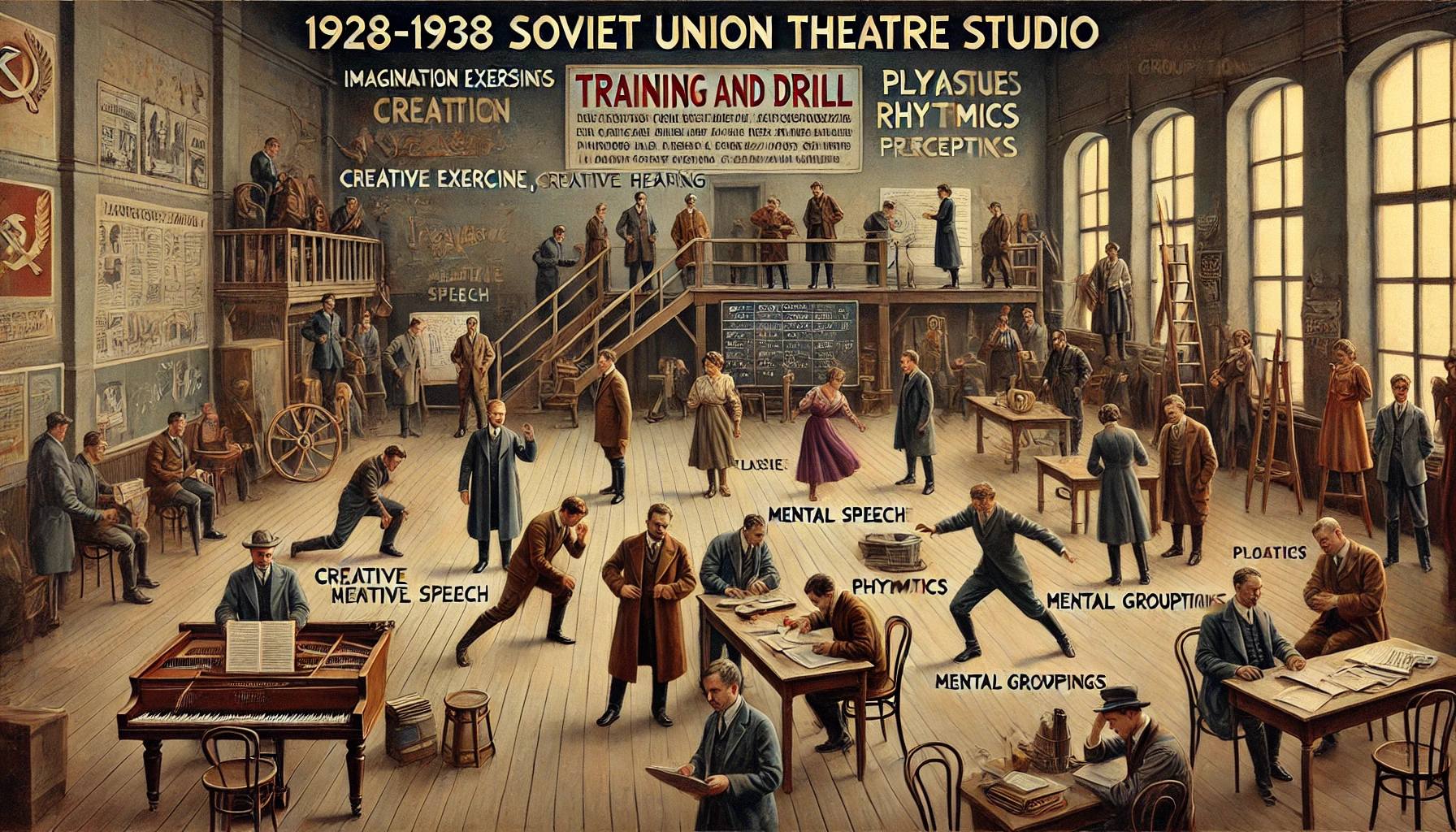
Anyone examining Stanislavski’s manuscripts and notebooks from 1928-1938 will often find notes under titles such as “training and drill” or “taskbook.”
Under such headings, he recorded various exercises and etudes, often in outline form—sometimes just as a title.
Within these manuscripts, one can find exercises designed to train the actor’s instrument—his imagination, creative hearing, skills of mental speech, and development of sensory perception.
Additionally, there were exercises for plasticity, rhythm, stage groupings, mise-en-scène, handling cloaks and swords, speech training, posture, gait, gestures—some marked simply as material for future development, while others were detailed more extensively.
The Vision of the Taskbook
It is evident that Stanislavski envisioned a future “Taskbook” as a comprehensive collection of exercises covering all aspects of an actor’s psychophysical technique.
In this book, titled “Training and Drill,” Stanislavski wrote in a draft introduction to An Actor’s Work on Himself:
“All practical exercises will be gathered, through which students will truly assimilate what they have been taught theoretically. Furthermore, as a visual representation for the second and third volumes and for ‘Training and Drill,’ I plan to shoot a film and record a series of phonograph records. The photographs will demonstrate exercises in actions related to ‘working on oneself and on the role,’ and the phonograph records will convey everything related to sound, voice, intonation, and speech.”
This vastly planned variety of psychophysical training methods is precisely what is missing in the contemporary training of those who claim to practice Stanislavski today.